
How the Journey Began

Updated: Mar 9
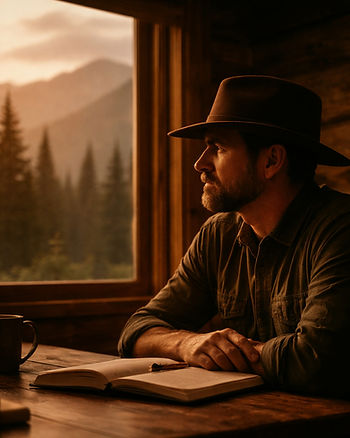
In my first post, I shared what kind of stories I write and what readers can expect from them. This one is a bit more personal. It’s about why this story began at all—and why it took shape when it did.
For a long time, writing fiction felt like something other people did. Not because creativity was absent from my life, but because it had always expressed itself in other forms. Creativity has long been part of both my father’s life and mine—through pencil sketches, woodworking, metallurgy, photography, and cinematic videography. Storytelling, in one way or another, was always present. Writing a novel simply became the next evolution of that creative thread, rather than a sudden departure from it.
Both my father and I were engineers by profession. We shared that focused, methodical mindset—the kind that values structure, discipline, and precision. Yet alongside that technical rigor existed a creative side that often surprised people. Those who knew us primarily through our professional work rarely expected the depth of imagination or emotional expression that surfaced through our creative outlets.
In fact, many people who know me as an engineer were genuinely surprised when they learned I had written a novel—especially one shaped by atmosphere, restraint, and emotional depth. More than a few said some version of, “I didn’t know you had that in you.” But that creative current was always there. The engineering world became the way I made a living; creativity remained the place where meaning, exploration, and reflection lived more freely.
That shift toward long-form storytelling happened during a season marked by both loss and uncertainty.
I lost my father—a man whose character, integrity, and quiet strength shaped me in ways I had always known and deeply respected. Around that same period, a significant professional setback forced me to slow down and reassess the pace and direction of my life. It was a disorienting moment, but also one that created rare stillness. For the first time in years, there was room to think, to reflect, and to listen more carefully.
Out of that space, an idea began to form.
✦ ✦ ✦
I didn’t start writing with a message in mind. I started with a person. A quiet one. Someone who moved through the world without seeking attention, who helped where he could, and who understood that real courage is often unseen. Eli Shephard emerged not as a symbol or a sermon, but as a presence—steady, restrained, and guided by an internal compass rather than external praise.
In many ways, Eli represents qualities I have always admired: humility over bravado, protection over power, conviction without noise. He isn’t meant to stand in the spotlight. He’s meant to stand in the gap.
Writing Shadows Among the Peaks became a way to explore those ideas honestly—without forcing conclusions or explaining everything outright. Faith plays a role in that exploration, but quietly. It informs the story’s moral center rather than announcing itself. I wanted to write something that respected readers enough to let meaning surface naturally, through choices and consequences, rather than through exposition.
The same is true of the story’s darker elements. Evil is present, but it is not indulged. The focus remains on resistance, on courage, and on the small, often overlooked acts that push back against darkness. That balance mattered to me—not as a rule, but as a reflection of how I see the world.
This journey into writing wasn’t planned or strategic. It unfolded gradually, during a time when listening mattered more than rushing. What began as an experiment became a story that asked to be finished.
I’m grateful you’re here to walk some of that path with me.
In future posts, I’ll share more about Eli, the places he travels, and the themes that continue to shape this series. For now, thank you for taking the time to read—and for being part of a journey that began quietly, but has already gone farther than I ever expected.

Comments